

Prediction Markets Are Making Everything A Commodity — Including Women
What happens when everything becomes something to bet on, including us?


Kalshi and Polymarket, the biggest prediction market platforms, are making a big push to entice women to trade on their platforms. After building their audience with young men (often specifically targeting the working class), marketing teams see women as an untapped market for prediction markets.
So far, their main acquisition strategy has been influencer marketing. You might have seen Kalshi and Polymarket recruiting lifestyle influencers to flood feeds with familiar TikTok taglines like “girl math” or “I’m just a girl” to explicitly counter the bro-y vibe of most prediction market platforms.
But lately, they’re using the popularity of dating shows like Love Island to encourage trading on reality TV.
But what are prediction markets?
Prediction Markets claim their goal is to “financialize everything.” Users make trades on event predictions to earn (or more often, lose) money based on the outcome, allegedly all for greater social knowledge.

Not according to the Commodity Futures Trading Commission (CFTC). The legal loopholes are tricky but here’s the gist: users are allegedly trading with each other, not a “house.”
This positioning is sinister. Prediction markets claim that they exist for the underdog, specifically, the working class — promising the opportunity to build generational wealth. The system is rigged, they say. But instead of working to create a more equitable future, they offer users a false sense of control, without the mental health protections mandated to gambling and betting sites. Prediction markets make money from a participation model. The more trades, the better. Therefore, the more people, the better.
Which is why they’re targeting a new group: women.
Their strategy is to bring financial doomerism to the fantasy suite
Right now, 71% of trades on Polymarket and Kalshi are from sports-related outcomes. Behind sports, crypto has the next highest market share with about 14%. Culture trades — which include reality TV winners, box office numbers, and even celebrity Tweet volume — hold less than 0.1% of the market share. But thanks to Love Island USA Season 8, that number may be growing.
Audiences, particularly women, found themselves coming to the platforms for the first time. Love Island markets on Kalshi have three times more women traders than average markets — two thirds of which are new traders.
This is not by accident. Prediction markets are heavily investing in both disclosed and undisclosed partnerships with influencers and creators posting about Love Island to increase their visibility to new audiences.
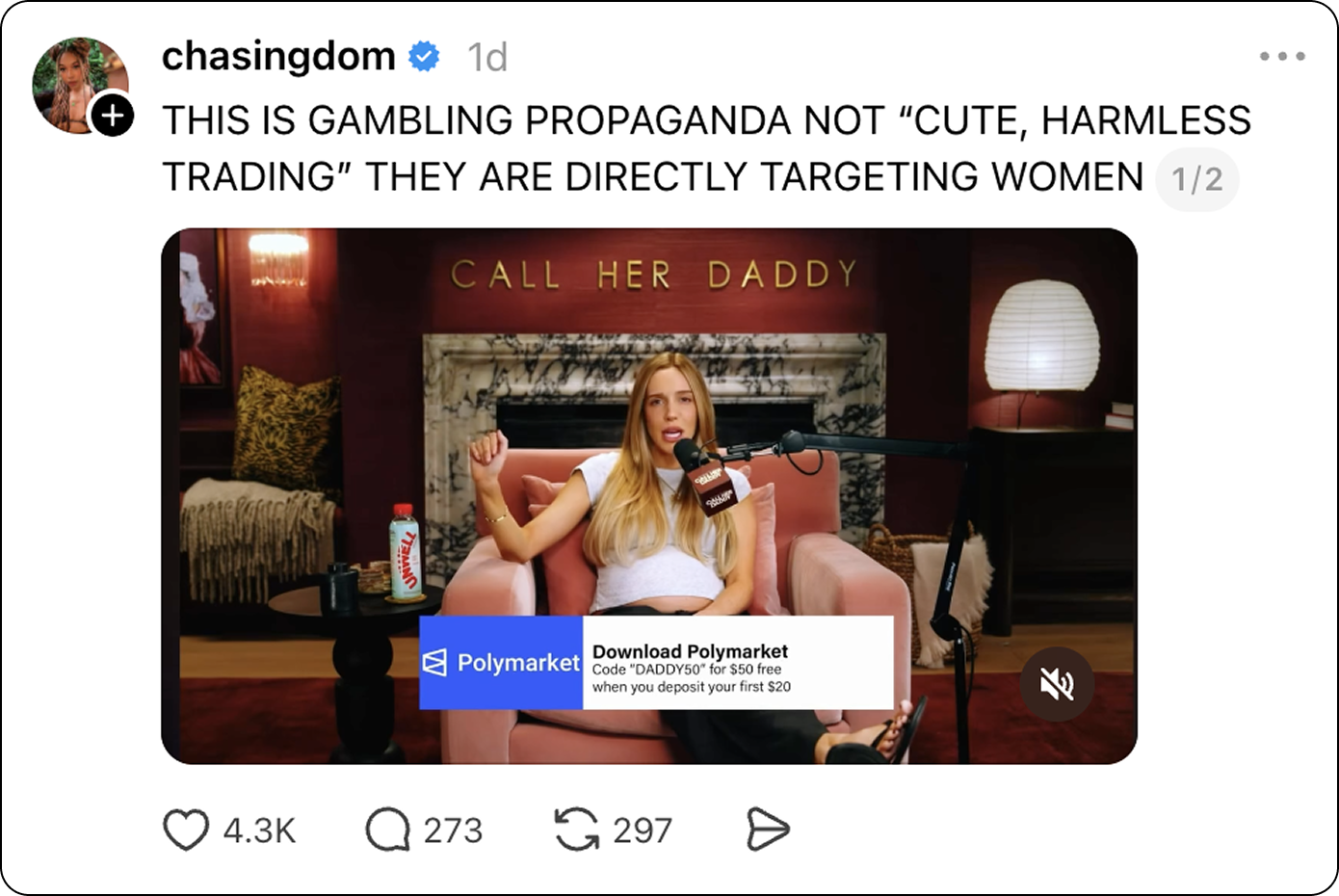
But contrary to their messaging, the push for women traders is not an altruistic effort to help close the wage gap or empower women. It’s also not just to strengthen their prediction model for supposed intellectual good. The platforms benefit from more users making more trades, which makes them more money.
Why are prediction markets appealing to women?
They seem like an easier path to financial freedom than any of the pathways promised to them. The girlbossing isn’t dead, she’s in her gambling era — and it’s consistent with Gen Z’s attitude toward work and money.
The girlboss era preached working hard to reap the rewards of capitalism. It believed that more women with more money would make things more equitable for everyone — sound familiar? Gen Z’s financial outlook is much more cynical. “Capitalism” has become a colloquial scapegoat, rather than a system to interrogate, let alone fix. Instead, it’s the reason for a generational financial nihilism.
Taking advantage of the generational discontent, prediction markets are turning their advertisements on women who are more into “quiet quitting” than girlbossing. In a time where women on the internet seem to have two options — tradwiferism and girlbossing — prediction markets claim to fill the gap by giving women financial agency not afforded to them by the system.

Prediction markets don’t give women more agency; platforms like Kalshi and Polymarket just further commodify women.
“Financializing” everything means people make money on predictable outcomes using pattern recognition. Your “edge” on these platforms is the past (when it isn’t just insider information, which it often is). Prediction markets incentivize an emotional attachment to the past, rewarding traders for resisting change and further entrenching existing biases.
No wonder users can bet on war, discrimination, and starving children in war zones. Kalshi even ran an ad parodying a historical bet on segregation. These markets don’t change the world, they desensitize people to its atrocities. And even make people root for them.
Trading on reality TV might seem innocuous. But a market largely controlled by men cashing out on a female-dominated industry feels like commodification. The value of women to these platforms is purely monetary — whether the women are users or the subjects of trades.
Prediction markets want to make everything a commodity. Marginalized groups, who have already been objectified by capitalism, are especially vulnerable — not just to the “Get-rich-quick” messaging but their cultural side effects.
What happens when people are incentivized to root for the status quo when the status quo looks like this?